ResumeFit AI — Building an AI-Assisted Resume Analysis Platform for Job Seekers
- 3upload/analyze/improve
- Workflow steps
- 6+report categories
- Score areas
- 2captured assets
- Screenshots
Project Overview
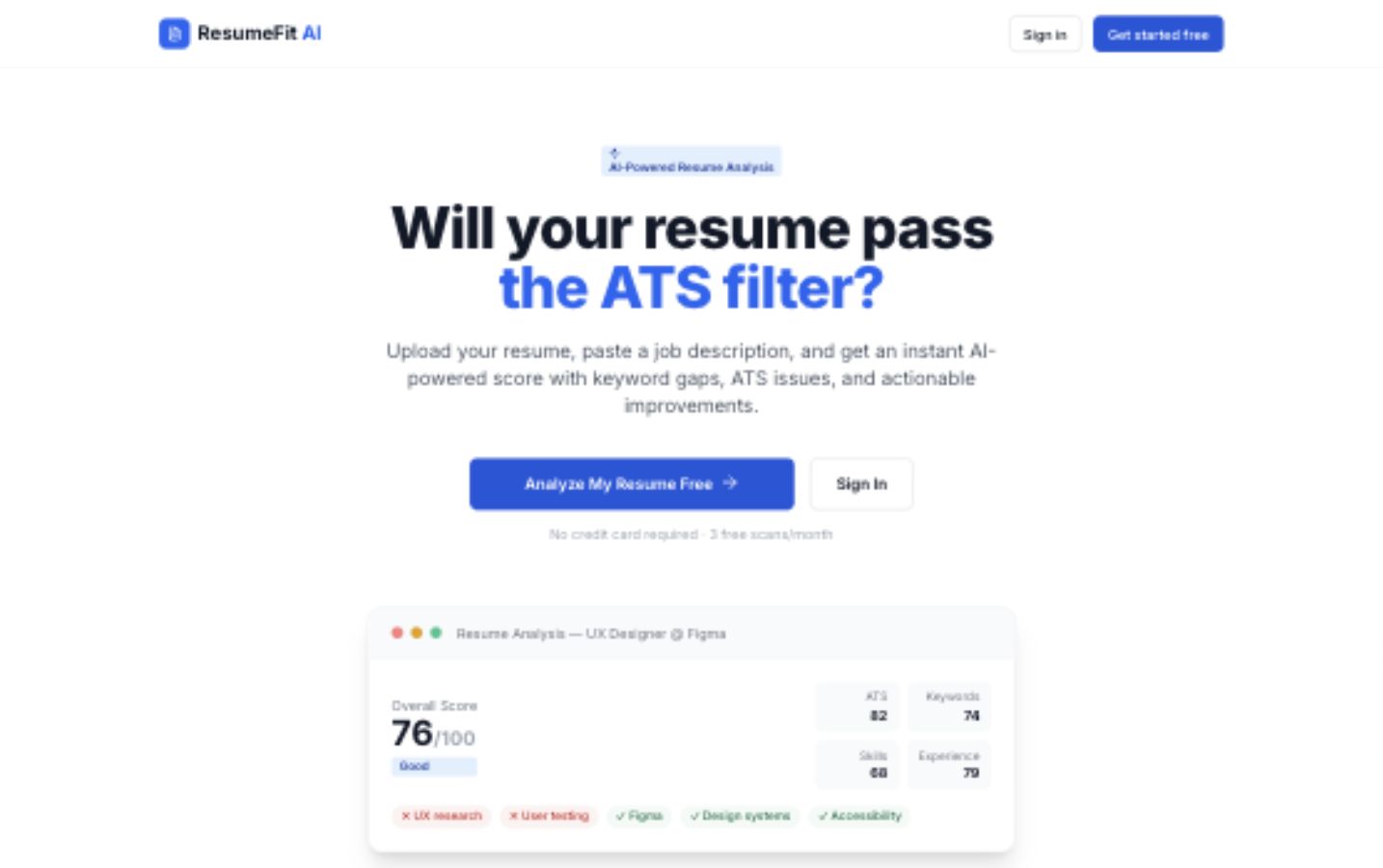
ResumeFit AI is a web application that helps job seekers understand how well their resume matches a specific role before they apply. The product analyzes a resume against a target job description and produces an actionable report.
The report covers ATS compatibility, keyword coverage, skill alignment, experience relevance, formatting, impact, rewrite opportunities, and prioritized improvements.
This case study is public-safe: sensitive implementation details, credentials, private routes, private API details, exact security internals, and vulnerable operational details are intentionally omitted or generalized.
Generic Resume Feedback Is Not Enough
Job seekers often receive little feedback when applications are rejected. Generic resume tools may provide broad advice, but candidates need role-specific guidance tied to a target job description.
The challenge was to distinguish between exact wording gaps, conceptually related skills, true experience gaps, formatting issues, and weak presentation without over-penalizing adjacent terminology.
From Upload to Actionable Next Steps
The product needed a clear workflow: upload a resume, add a job description, run analysis, review the score report, open improvement suggestions, and export the report.
Success meant the user could move from uncertainty to a practical improvement plan, with clear explanations rather than opaque AI judgment.
Understanding Resume Review Pain Points
The product direction was shaped around job-seeker pain points: unclear rejection reasons, confusing ATS advice, repetitive manual tailoring, and difficulty translating a job description into resume edits.
Testing showed that AI feedback needed stronger guardrails. The system had to recognize related UX, UI, frontend, accessibility, and design-system evidence rather than relying only on literal keyword overlap.
Designing and Refining with Agentic AI
I used agentic AI as a collaborator for ideation, implementation support, debugging, testing, content generation, and iteration. I directed the workflow, reviewed outputs, made product decisions, refined prompts, tested flows, and adjusted behavior.
The process moved through multiple iterations: core workflow, parsing reliability, AI model fallback, report generation, improve-page behavior, report download, and analysis-quality refinement.
A Structured Report with Prioritized Improvements
The final experience gives users an overall score, category breakdown, failure reasons, gap analysis, keywords, strengths, weaknesses, ATS issues, rewrite suggestions, and a roadmap.
The Improve Resume page turns the analysis into a focused action list, while export support lets users save the report for later review.
Clear, Readable, and Keyboard-Friendly Flows
The UI uses labeled forms, visible progress states, clear button text, readable contrast, and structured report sections that assistive technologies can scan.
Error and success messages are written to be understandable without relying only on color, and the app guides users toward ATS-readable resume formats.
Outcomes
ResumeFit AI shipped a functioning product flow from resume upload to job-specific report and improvement guidance.
The system became more reliable after improving model fallback, resume parsing behavior, report execution flow, and analysis prompt quality.
Recommended future metrics include upload-to-report completion rate, average analysis time, report revisit rate, export rate, and user-perceived usefulness.
What I Learned
AI products need product judgment, not just prompts. Without structure, AI feedback can overstate issues or miss related evidence.
Better outcomes came from combining deterministic logic, semantic guidance, careful UX, and iterative testing.